

Product Categories
SEARCH WHAT YOU WANT
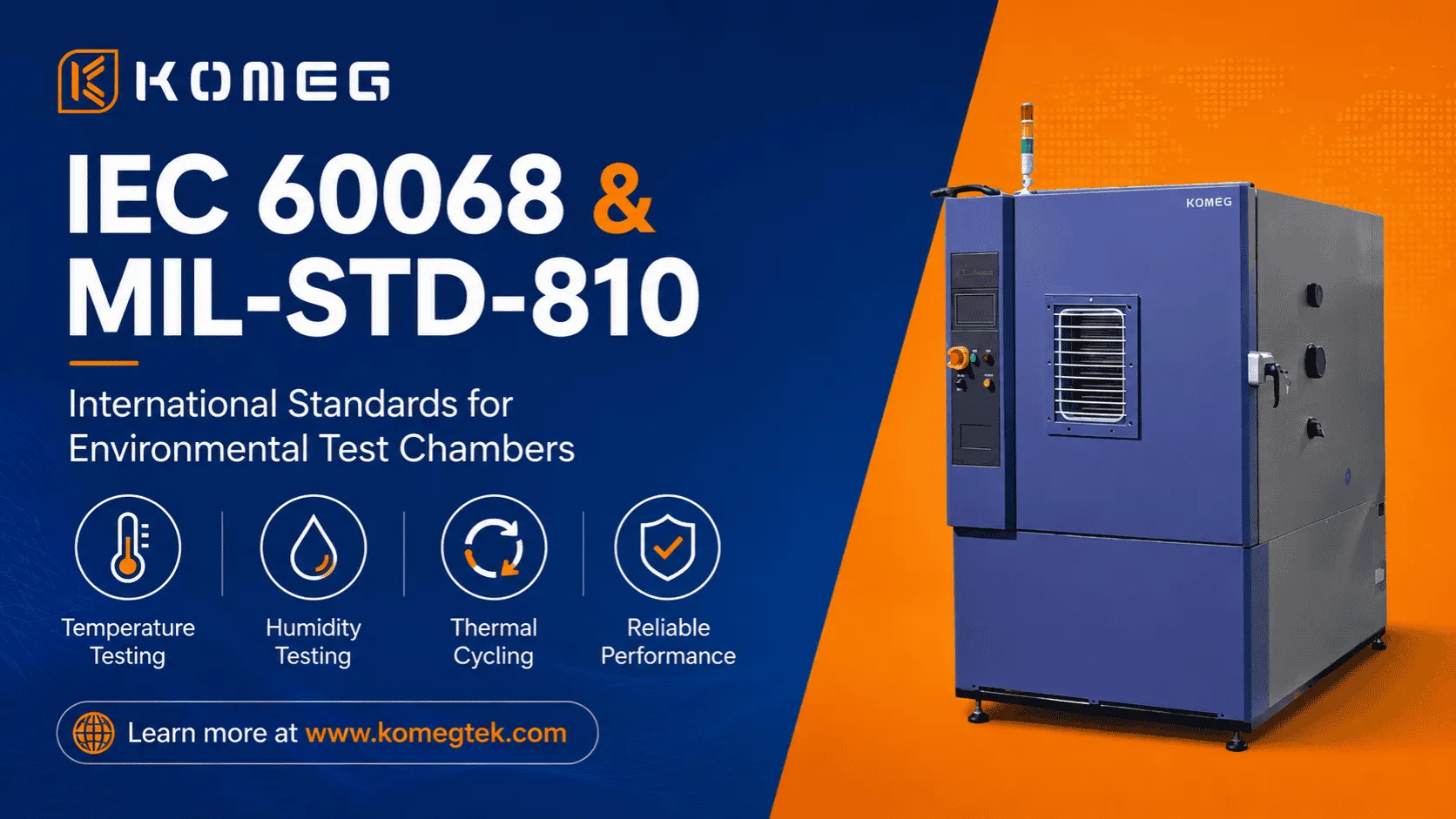
Environmental test chambers are widely used to evaluate how products perform under controlled temperature, humidity, and other environmental conditions. However, selecting a chamber based only on its temperature range or chamber volume is not enough for many reliability and qualification programs. Engineers also need to understand the environmental testing standard behind the test, the required test method, and how the chamber needs to reproduce the specified conditions.
Two important references frequently encountered in environmental testing are IEC 60068 and MIL-STD-810. Although both are widely used for environmental reliability testing, they serve different purposes and should not be treated as interchangeable chamber specifications.
IEC 60068 is a family of environmental testing methods covering conditions such as cold, dry heat, temperature change, damp heat, vibration, and other environmental stresses. MIL-STD-810, meanwhile, provides an environmental engineering and laboratory testing framework that emphasizes selecting and tailoring test conditions according to the equipment's intended service environment.
Understanding these differences helps engineers choose an appropriate environmental test chamber, develop more representative test profiles, and avoid the common mistake of selecting equipment simply because it reaches a particular temperature.
Products rarely operate in perfectly controlled environments. Electronics may experience temperature changes during transportation and outdoor operation, automotive components can be exposed to heat, cold, and humidity, and aerospace or defense equipment may encounter significantly more demanding environmental conditions throughout its service life.
Environmental testing is used to reproduce selected environmental stresses under controlled and repeatable laboratory conditions. The objective may be to evaluate product durability, identify weaknesses, validate a design, support qualification, or investigate how materials and assemblies respond to environmental exposure.
Standards provide a common framework for defining these tests. They help engineers specify conditions such as temperature, humidity, exposure time, temperature transitions, specimen configuration, and measurement requirements.
For an environmental chamber manufacturer, this distinction is important. A chamber is the test equipment; the standard defines the test method and requirements that the equipment needs to support. A chamber does not automatically become compliant with a particular standard simply because it can reach a specified temperature.
IEC 60068 is a series of international environmental testing standards developed by the International Electrotechnical Commission (IEC). The series provides standardized methods for evaluating components, equipment, and other products under specified environmental conditions.
IEC 60068 includes many different test methods. For environmental chambers, some of the most relevant are tests involving low temperature, dry heat, temperature changes, and damp heat.
The specific test method matters because a low-temperature exposure test is fundamentally different from a test designed to evaluate the effects of repeated temperature changes. Likewise, a dry-heat test is different from a cyclic damp-heat test where temperature and humidity are controlled together.
This is why engineers should identify the exact IEC 60068 test method before selecting an environmental chamber.
IEC 60068-2-1:2025, Test A: Cold, specifies low-temperature tests for non-heat-dissipating and heat-dissipating specimens. The standard is used to determine the ability of components, equipment, or other products to be used, transported, or stored at low temperature. It applies to both energized and non-energized specimens that normally reach temperature stability during the test.
An important point is that IEC 60068-2-1 specifically addresses low-temperature exposure. The IEC publication notes that it does not specify tests for determining the effects of temperature changes on specimens. That distinction is important when deciding between a conventional temperature chamber and a chamber designed for rapid or repeated temperature transitions.
For cold testing, engineers should consider more than the chamber's minimum temperature. Airflow, temperature stability, measurement points, specimen thermal characteristics, and actual loading conditions can all influence the test result.
KOMEG's Temperature Test Chambers are designed for controlled high- and low-temperature testing, with standard chamber sizes from 64 L to 1000 L and customized configurations available for more demanding applications.
IEC 60068-2-2:2025, Test B: Dry Heat, specifies high-temperature dry-heat tests for heat-dissipating and non-heat-dissipating specimens. The purpose is to evaluate the ability of components, equipment, and other products to operate, be transported, or be stored under high-temperature conditions.
Similar to the cold test, dry-heat testing is primarily concerned with exposure to a controlled high-temperature environment. It should not automatically be confused with a temperature-change test.
The 2025 edition also clarifies issues including chamber air velocity, measurement points around or within specimens, temperature tolerances, and test reporting requirements. These details demonstrate why simply specifying a chamber's maximum temperature is not enough to evaluate its suitability for an environmental test.
For products with significant heat generation, the situation becomes even more important. A powered electronic assembly may behave differently from a passive specimen because the product itself changes the thermal conditions around the test item.
When the test objective involves repeated changes between different temperature conditions, IEC 60068-2-14:2023, Test N: Change of temperature, becomes particularly relevant.
The standard provides tests involving specified ambient temperature changes to analyze their effects on specimens. The current 2023 edition revised specimen temperatures, severities, tolerances, and reporting requirements for temperature-change testing.
This is an important distinction:
Temperature exposure and temperature change are not the same test.
A conventional temperature test may hold the specimen at a defined high or low temperature for a specified period. A temperature-change test, in contrast, introduces transitions between different environmental conditions. Those transitions can generate mechanical stress because different materials expand and contract at different rates.
This is particularly relevant to:
For applications where the rate of temperature change is a critical part of the test profile, a Rapid-Rate Thermal Cycle Chamber may be more appropriate than a conventional temperature chamber. KOMEG's rapid-rate chambers are available with specified heating and cooling rates and are designed for temperature cycling and environmental stress screening applications.
IEC 60068-2-30:2025, Test Db: Damp Heat, Cyclic, evaluates products under high humidity combined with cyclic temperature changes. The procedure generally produces condensation on the specimen surface and can also be used to validate packaging for transportation and storage.
This type of test requires control of both temperature and relative humidity. Therefore, the chamber needs to provide stable humidity control as well as appropriate temperature performance.
Factors such as humidity recovery, airflow, condensation, water management, temperature uniformity, and humidity uniformity can affect the actual environmental conditions experienced by the specimen.
KOMEG's Temperature and Humidity Test Chambers are designed to simulate controlled temperature and humidity environments for reliability testing across electronics, automotive, communication, medical, aerospace, and other applications. KOMEG's product range includes standard and customized chamber configurations, and the product page specifically references IEC 60068 applications.
MIL-STD-810, titled Environmental Engineering Considerations and Laboratory Tests, is a U.S. Department of Defense standard used to address environmental stresses throughout the service life of materiel.
One of the most important points to understand is that MIL-STD-810 is not simply a fixed environmental chamber specification.
The current DLA document record describes MIL-STD-810 as providing environmental engineering direction and states that it does not impose universal design or test specifications. Instead, it describes an environmental tailoring process that results in realistic designs and test methods based on system performance requirements.
This means engineers should not approach MIL-STD-810 as though there is one universal "MIL-STD-810 chamber temperature range."
The correct test conditions depend on the equipment, its intended environment, lifecycle, operational requirements, and the specific test method being applied.
The environmental tailoring concept is one of the defining characteristics of MIL-STD-810. The standard's guidance emphasizes selecting and tailoring methods rather than applying laboratory tests as unchangeable routines.
Although IEC 60068 and MIL-STD-810 are both associated with environmental testing, their approaches are different.
IEC 60068 provides a broad family of standardized environmental test methods. Engineers select the applicable test method according to the environmental condition being evaluated, such as cold, dry heat, temperature change, or damp heat.
MIL-STD-810 provides an environmental engineering and test framework that emphasizes tailoring. The test conditions are selected according to the equipment's intended service environment and performance requirements.
This difference matters when selecting an environmental test chamber.
For an IEC 60068 test, the engineer may start with a defined test such as IEC 60068-2-1, IEC 60068-2-2, IEC 60068-2-14, or IEC 60068-2-30 and then identify the required chamber conditions.
For a MIL-STD-810 program, the engineer should first identify the applicable method and environmental profile, then determine how the laboratory test needs to reproduce the relevant service conditions.
Therefore, neither IEC 60068 nor MIL-STD-810 should be reduced to a single chamber specification.
The chamber is selected based on the actual test profile.
Environmental test chambers can support many different test profiles, but the chamber configuration should always follow the requirements of the selected test method.
Temperature testing is used to evaluate product behavior under high- or low-temperature conditions. Depending on the test method, the specimen may be energized or non-energized and may need to reach temperature stability before measurements are taken.
For these applications, a temperature chamber needs stable temperature control, appropriate airflow, sufficient temperature range, and adequate performance under the actual specimen load.
KOMEG Temperature Test Chambers cover a broad range of standard applications and can also be customized for specific temperature testing requirements. The current product range includes standard sizes from 64 L to 1000 L and larger customized configurations.
Temperature cycling exposes a product to repeated temperature transitions. This can reveal weaknesses caused by differences in thermal expansion between materials.
For example, a PCB assembly may contain silicon devices, copper conductors, solder, FR-4 substrates, plastics, and other materials. Each material responds differently to temperature changes. Repeated cycling can therefore generate mechanical stress at interfaces and connections.
The temperature ramp rate becomes especially important when the test method requires relatively fast transitions.
KOMEG's Rapid-Rate Thermal Cycle Chambers are designed for rapid thermal transitions and environmental stress screening. The current KST series lists heating and cooling rates of 5°C/min, 10°C/min, and 15°C/min for specified configurations, with linear and non-linear control options.
When moisture is part of the environmental stress, temperature alone is not sufficient. Humidity must also be controlled and monitored.
Damp heat testing can expose products to moisture-related mechanisms such as condensation, corrosion, insulation degradation, material swelling, and other forms of environmental deterioration.
The chamber should therefore be evaluated for both temperature and humidity performance rather than temperature range alone.
For applications involving cyclic damp heat, KOMEG's Temperature and Humidity Test Chambers provide controlled temperature and relative humidity conditions with standard and customized configurations.
There is no single specification that applies to every environmental test chamber used with IEC 60068 or MIL-STD-810. The required chamber performance depends on the selected test method and the characteristics of the specimen.
Several parameters should be considered.
The chamber must cover the required test temperatures with sufficient operating margin. However, a wider temperature range is not automatically better.
If a test requires a relatively narrow range, an unnecessarily large temperature range may add cost and complexity without improving the test.
The important question is:
Can the chamber reliably reproduce the required test profile under the actual load?
Temperature uniformity describes how evenly the environmental condition is distributed throughout the usable workspace, while temperature stability concerns how consistently the condition is maintained over time.
These parameters become particularly important when:
A chamber may show excellent empty-chamber performance but behave differently once a large or heat-generating specimen is installed.
For temperature-change testing, ramp rate can be a critical parameter.
A chamber that can reach -40°C and +85°C may still be unsuitable for a test requiring rapid transitions if its heating or cooling capacity is insufficient under load.
The actual product temperature can also lag behind chamber air temperature. Therefore, engineers should consider both chamber performance and specimen thermal response.
For damp-heat testing, the chamber must maintain the required relative humidity over the relevant temperature range.
Humidity stability and uniformity become especially important during long-duration tests. Condensation management also matters when the test method intentionally creates moisture on the specimen.
IEC 60068-2-30:2025 specifically includes requirements related to the test chamber, temperature tolerances, conditioning temperature and relative humidity limits, and intermediate measurements.
Airflow is sometimes overlooked when comparing environmental chambers.
The position, size, thermal mass, and heat dissipation of the DUT can influence the environmental conditions around it. The current IEC 60068-2-1 and IEC 60068-2-2 publications include clarifications related to air velocity and measurement points around, on, or in specimens.
For this reason, chamber selection should consider the actual specimen configuration rather than relying only on empty-chamber specifications.
A reliable environmental test also depends on accurate measurement.
Temperature and humidity sensors need appropriate calibration, measurement points need to reflect the test requirements, and test data should be recorded in a traceable manner.
For large environmental chambers, calibration can become more complicated because of chamber size, airflow distribution, sensor locations, and thermal gradients. Engineers can also refer to KOMEG's technical guide on walk-in temperature and humidity chamber calibration for additional considerations.
Selecting a chamber for IEC 60068 should begin with the specific test method, not the chamber catalog.
Determine whether the test involves:
For example, IEC 60068-2-1 and IEC 60068-2-2 address low- and high-temperature exposure, while IEC 60068-2-14 addresses temperature changes.
Identify:
This information determines the actual chamber performance required.
The thermal characteristics of the DUT should be considered before selecting the chamber.
A small passive electronic component and a large powered battery pack can have completely different thermal loads. The chamber must be capable of maintaining the required environmental conditions with the actual product installed.
Chamber volume should provide enough space for the specimen and allow appropriate airflow around it.
For large assemblies or multiple products, a conventional reach-in chamber may not be sufficient. In such cases, a walk-in configuration may be more appropriate.
Modern environmental testing may require:
These requirements should be considered before purchasing the equipment rather than added later.
Selecting a chamber for MIL-STD-810 requires a slightly different approach because the standard emphasizes environmental tailoring.
The first step is to identify the applicable test method and understand the actual environmental conditions the equipment is expected to experience.
For temperature-related tests, engineers may need to consider:
The goal is not to create the harshest possible laboratory environment. Instead, the test should reproduce meaningful environmental stresses that are relevant to the equipment's intended service conditions.
This is consistent with the environmental tailoring philosophy described by MIL-STD-810. The DLA documentation emphasizes that laboratory methods should be selected and tailored to produce relevant test data rather than applied as fixed, universal routines.
As products become larger, traditional benchtop and reach-in chambers may no longer provide sufficient test volume.
A Walk-In Environmental Test Chamber is designed for large components, assemblies, finished products, or multiple specimens that cannot be accommodated in conventional chambers.
Typical applications include:
The value of a walk-in chamber is not simply its size. Large-scale testing also requires careful management of airflow, temperature uniformity, humidity control, thermal load, cable routing, access, and safety.
KOMEG's walk-in environmental chambers are designed for large components, assemblies, and finished products under controlled temperature and/or humidity conditions. The company offers standard configurations as well as customized chamber solutions based on specimen dimensions and quantity.
For engineers working with large automotive, battery, aerospace, or industrial systems, this type of chamber can provide considerably more flexibility than a conventional laboratory chamber.
KOMEG develops and manufactures environmental test chambers for temperature, humidity, thermal cycling, and large-scale environmental simulation applications. Its product range includes Temperature and Humidity Test Chambers, Temperature Test Chambers, rapid-rate thermal cycle chambers, walk-in environmental chambers, battery thermal test chambers, thermal shock chambers, HAST chambers, altitude chambers, and other specialized systems.
For conventional cold and dry-heat applications, KOMEG temperature chambers provide controlled high- and low-temperature environments with a range of standard chamber sizes and customized options.
For tests involving temperature and humidity, KOMEG temperature and humidity chambers are designed to simulate controlled heat, cold, and moisture conditions. The product range includes standard sizes from 64 L to 1000 L and larger customized systems.
For temperature-change and environmental stress screening applications, KOMEG Rapid-Rate Thermal Cycle Chambers provide controlled rapid thermal transitions. Current KST configurations include selectable ramp rates and linear or non-linear control options depending on the application.
For large products and assemblies, KOMEG Walk-In Environmental Test Chambers provide large test volumes and can be customized according to product dimensions, sample quantity, temperature requirements, and humidity requirements.
The key is not to select a chamber simply because it carries a standard-related marketing label. The chamber should be configured around the actual test method, specimen characteristics, environmental profile, and measurement requirements.
IEC 60068 contains multiple environmental test methods, while MIL-STD-810 uses environmental tailoring. Neither should be interpreted as defining one universal environmental chamber.
The correct chamber depends on the specific test.
A chamber with the correct temperature range may still be unsuitable if its ramp rate, uniformity, humidity performance, airflow, or thermal-load capability does not match the test requirements.
Temperature range is only one part of chamber selection.
A large or powered DUT can significantly influence the environmental conditions inside the chamber.
Engineers should therefore evaluate chamber performance with the expected test load whenever possible.
A constant high-temperature test and a temperature-change test have different objectives.
IEC 60068-2-2 specifically addresses dry heat, while IEC 60068-2-14 addresses the effects of specified ambient temperature changes.
Using the wrong test profile can produce data that does not answer the original reliability question.
Environmental testing standards are periodically revised. IEC 60068-2-1 and IEC 60068-2-2 were both updated in 2025, while IEC 60068-2-14 is currently the 2023 edition and IEC 60068-2-30 has a 2025 edition.
Before starting a qualification program, engineers should verify the edition referenced by the applicable product specification, customer requirement, certification program, or internal test procedure.
IEC 60068 provides a family of environmental test methods used to evaluate components, equipment, and products under specified environmental conditions. Relevant methods include cold, dry heat, temperature change, and damp heat testing.
MIL-STD-810 provides environmental engineering considerations and laboratory test methods for evaluating equipment against environmental stresses that may occur during its service life. It emphasizes environmental tailoring rather than one universal test profile.
No. IEC 60068 is a family of environmental testing methods. The applicable test method determines the environmental conditions and performance requirements that the test equipment needs to reproduce.
No. MIL-STD-810 does not impose one universal temperature range for every test. Test conditions should be selected and tailored according to the equipment, intended environment, and applicable test method.
In many cases, yes, depending on the chamber configuration. A temperature chamber may support multiple temperature-related tests, while a temperature and humidity chamber can support tests requiring both environmental variables. However, the chamber's actual performance must be checked against each test method.
Start with the applicable test method and define the complete test profile. Then evaluate temperature range, ramp rate, humidity, uniformity, stability, specimen thermal load, chamber volume, airflow, safety, measurement, and data-recording requirements.
IEC 60068 and MIL-STD-810 are important references for environmental reliability testing, but neither should be treated simply as a specification for buying an environmental test chamber.
IEC 60068 provides a broad family of standardized environmental test methods, including cold, dry heat, temperature change, and damp heat. MIL-STD-810 takes an environmental engineering and tailoring approach, with test conditions selected according to the equipment's intended service environment and performance requirements.
For engineers selecting test equipment, the most important question is therefore not simply whether a chamber can reach a particular temperature. The chamber needs to reproduce the complete environmental test profile under the actual specimen load, including temperature, humidity, ramp rate, airflow, stability, uniformity, and measurement requirements.
Whether the application involves component qualification, automotive electronics, semiconductor reliability, battery systems, aerospace equipment, or large industrial assemblies, selecting the chamber according to the actual test method is essential for obtaining repeatable and meaningful results.
KOMEG provides standard and customized environmental test chambers for temperature, humidity, thermal cycling, and large-scale environmental testing applications. If you are developing an IEC 60068 or MIL-STD-810 testing program, KOMEG engineers can help evaluate the required chamber configuration based on your test profile and product characteristics.
Product Categories
Recent Posts
Copyright © 2026 GUANGDONG KOMEG INDUSTRIAL CO., LTD