

Product Categories
SEARCH WHAT YOU WANT
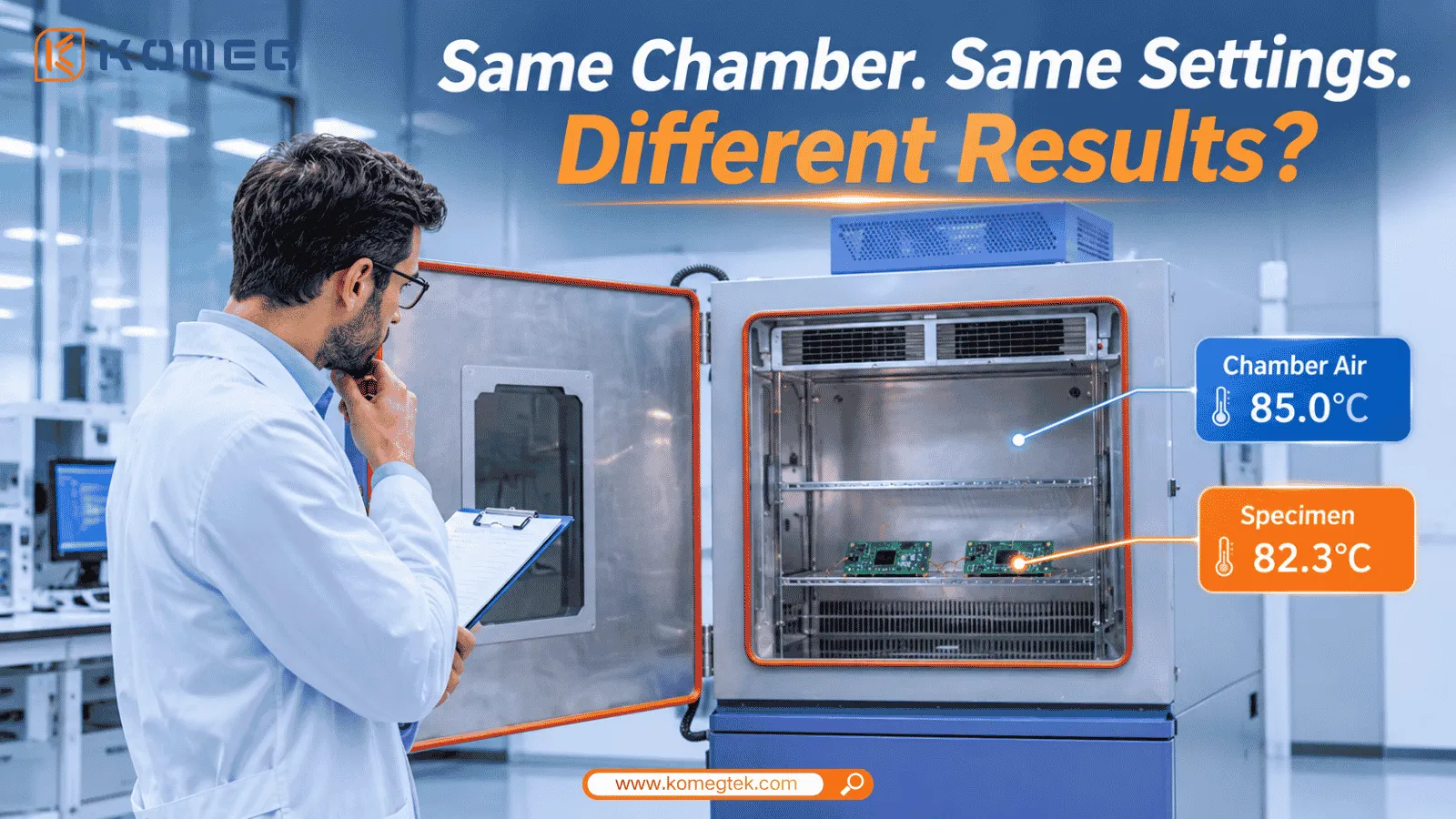
Environmental testing is designed to evaluate product reliability under controlled temperature, humidity, and other environmental stresses. However, engineers sometimes encounter an unexpected situation: two tests performed under seemingly identical conditions produce different results.
The temperature setting is the same. The test duration is unchanged. The same test chamber may even be used. Yet the test outcome, product performance, or observed failure point is different.
This does not necessarily mean the environmental test chamber is malfunctioning. In many cases, the difference comes from how the test conditions interact with the specimen, its surroundings, and the actual test setup.
Understanding these factors is essential for improving test repeatability and making environmental test results more meaningful.
One of the most overlooked factors in environmental testing is the test load.
A chamber may perform differently when testing a single small component compared with testing dozens of components simultaneously. Specimens absorb heat during heating and release heat during cooling. When the total load changes, the thermal demand placed on the chamber also changes.
Large, dense, or heat-generating specimens can influence the temperature distribution within the test space. Even when the chamber reaches its setpoint, the thermal conditions surrounding every specimen may not be identical.
For repeatable results, engineers should consider not only the number of specimens but also their mass, material, dimensions, arrangement, and heat dissipation characteristics.
The position of a specimen inside an environmental test chamber can influence its exposure to temperature and humidity.
Air circulation inside the chamber is affected by the arrangement of shelves, fixtures, specimens, and surrounding obstructions. Placing specimens too close together or blocking airflow paths may create localized differences in heat transfer.
This becomes particularly important when testing multiple specimens simultaneously or when using fixtures with complex geometries.
A repeatable specimen layout helps reduce unnecessary variation between test runs. The loading arrangement should remain consistent whenever test results are compared.
A test chamber controls the temperature of the circulating air within its working space. However, the specimen itself may not reach the same temperature at the same time.
The rate at which a specimen heats up or cools down depends on several factors, including:
Material thermal conductivity
Specimen mass and thickness
Internal structure
Surface area
Heat capacity
Contact with fixtures or mounting structures
For example, a thin PCB may respond relatively quickly to changing chamber conditions, while a thick metal assembly or battery module may require considerably more time for its internal temperature to stabilize.
This difference becomes particularly important during rapid temperature cycling. The chamber air may reach the target temperature long before the specimen's internal temperature does.
If the test duration begins based only on chamber air temperature, the actual exposure experienced by the specimen may differ from the intended test condition.
Fixtures and mounting structures are often necessary to position specimens securely during environmental testing. However, they can also affect heat transfer.
Metal fixtures may conduct heat away from a specimen or transfer heat into it. The contact area, fixture material, mounting method, and structural design can all influence the specimen's thermal response.
In some applications, a specimen mounted directly to a large metal fixture may experience a different thermal profile from one suspended or mounted using a thermally isolated support.
For comparative testing, fixture design and mounting conditions should be documented and kept consistent.
Temperature measurement is another potential source of variation.
A chamber controller typically regulates temperature based on a sensor positioned at a designated location. This measurement represents the temperature at the sensor location, not necessarily the temperature at every point inside the chamber or within the specimen.
During testing, additional monitoring sensors may be needed to evaluate temperature conditions near the specimen or at critical locations within it.
For products with complex thermal structures, measuring only chamber air temperature may not provide sufficient information to determine whether the specimen has reached the intended test condition.
The measurement method should therefore match the purpose of the test.
In temperature cycling and environmental conditioning tests, the timing of exposure is critical.
There is a difference between the time required for the chamber to reach a target temperature and the time required for the specimen to stabilize at that temperature.
If different test runs use different timing criteria, the actual thermal exposure may vary even when the programmed cycle is identical.
A test procedure should clearly define whether exposure time begins when the chamber reaches the setpoint, when the specimen reaches a specified temperature, or when another condition is satisfied.
Consistent timing criteria are particularly important when comparing test results between laboratories, different chambers, or different specimen batches.
When test results vary unexpectedly, changing the chamber temperature setting should not be the first response.
A more systematic approach is to review the entire test process:
Keep specimen quantity, dimensions, and loading arrangement consistent.
Maintain the same fixture and mounting method.
Avoid blocking chamber airflow paths.
Verify temperature sensor calibration and measurement location.
Consider specimen thermal mass and internal temperature response.
Standardize stabilization criteria and exposure time.
Record chamber conditions and specimen temperatures when necessary.
These steps help determine whether the variation comes from the equipment, the specimen, or the test procedure itself.
Environmental test repeatability depends on more than the temperature and humidity programmed into a test chamber. Specimen characteristics, loading conditions, airflow, fixtures, sensor location, and exposure timing can all influence the actual stress experienced by a product.
A reliable test is not simply one that reaches the specified setpoint. It is one in which the test conditions are properly defined, consistently applied, and representative of the reliability factors being evaluated.
When these variables are controlled, environmental testing becomes a more effective tool for identifying product weaknesses, comparing designs, and making confident engineering decisions.
For temperature cycling, humidity testing, and complex environmental reliability programs, selecting the appropriate chamber and defining the test setup together are essential to achieving meaningful and repeatable results.
Product Categories
Recent Posts
Copyright © 2026 GUANGDONG KOMEG INDUSTRIAL CO., LTD